Compare
How this differs
- 3
- channels that link accounts
- 9
- device surfaces closed inside the engine
- $14
- a month for 50 profiles
- 0.53 s
- to open a profile window, measured
Three channels that link accounts
A platform deciding whether two accounts belong to one person has three independent channels, and one is often enough. Storage, the device, the network.
A quieter fourth thing costs more accounts than you would expect: agreement. A macOS graphics string next to an x86 architecture hint describes a machine nobody has ever built.
Storage
Cookies, localStorage, IndexedDB, service workers and cache. Cleared by incognito, untouched by a VPN.
Device readings
Platform, screen, cores, memory, GPU, fonts, timezone, languages, canvas, WebGL and audio. One set per machine.
Exit IP
The address the site sees, plus the country, city and provider read from it.
What incognito actually clears
Incognito gives the session a temporary cookie jar and forgets it when the last window closes. It does that job well and was never meant to do more.
Everything outside that job belongs to your machine, so two incognito windows read as one computer. It forgets on purpose, so tomorrow's account is signed in again tomorrow.
What incognito changes
A temporary cookie jar, and no history entry once the window closes.
What it leaves alone
Every device reading and the exit IP.
What a profile does instead
Its own data directory on disk, kept between launches, with its own device and proxy.
Where incognito is still right
One throwaway login, one keystroke away, gone when you close it.
What a VPN leaves behind
A VPN moves traffic through another exit and is honest about being a network tool. Thirty accounts behind one exit share one IP, and they still share one browser.
ARMANOS does not hide your address either: you bring the proxy yourself.
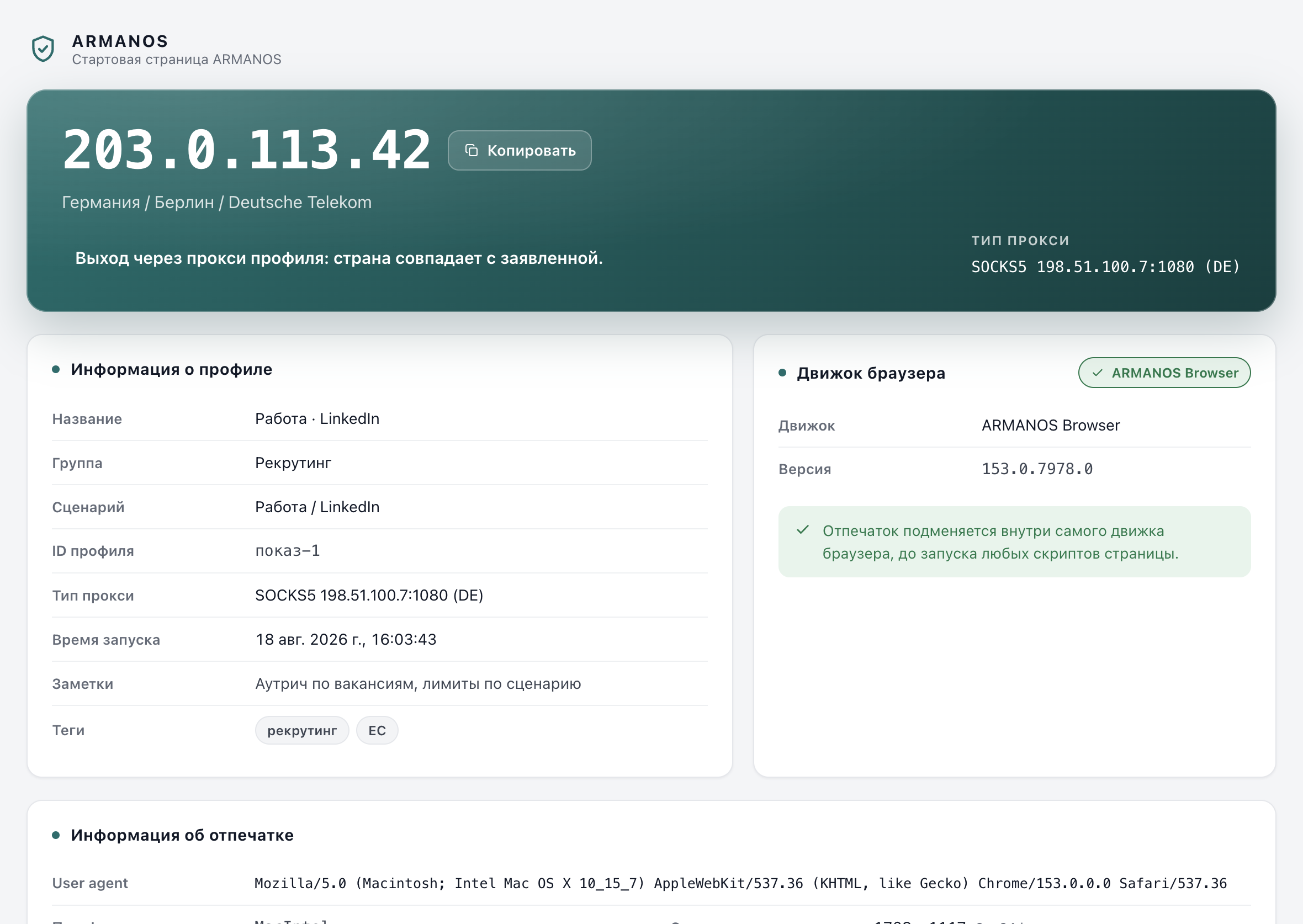
The place a site asks for out loud
Besides the address, a site can ask the browser for the position itself, and that needs your answer. Incognito, a second browser profile and a VPN hand over the machine's own position after "Allow", and it need not match the exit country.
A new ARMANOS profile hands over a point a few kilometres from where a directory puts its exit, and measures that place through the same proxy. In ARMANOS Browser on a Mac the point goes out, for now, only with "Share without asking" ticked.
A virtual machine per account
A virtual machine is a second computer in software, and the wall around it is thicker than ours. If your work needs that wall, use one.
The price is paid in resources and minutes: a system to keep patched, memory reserved, tens of gigabytes of disk and a boot before the first click. The numbers below were taken on a deliberately weak machine, so you see the worst case rather than the best.
- Machine
- MacBook M3, 8 cores, 8 GB
- Engine
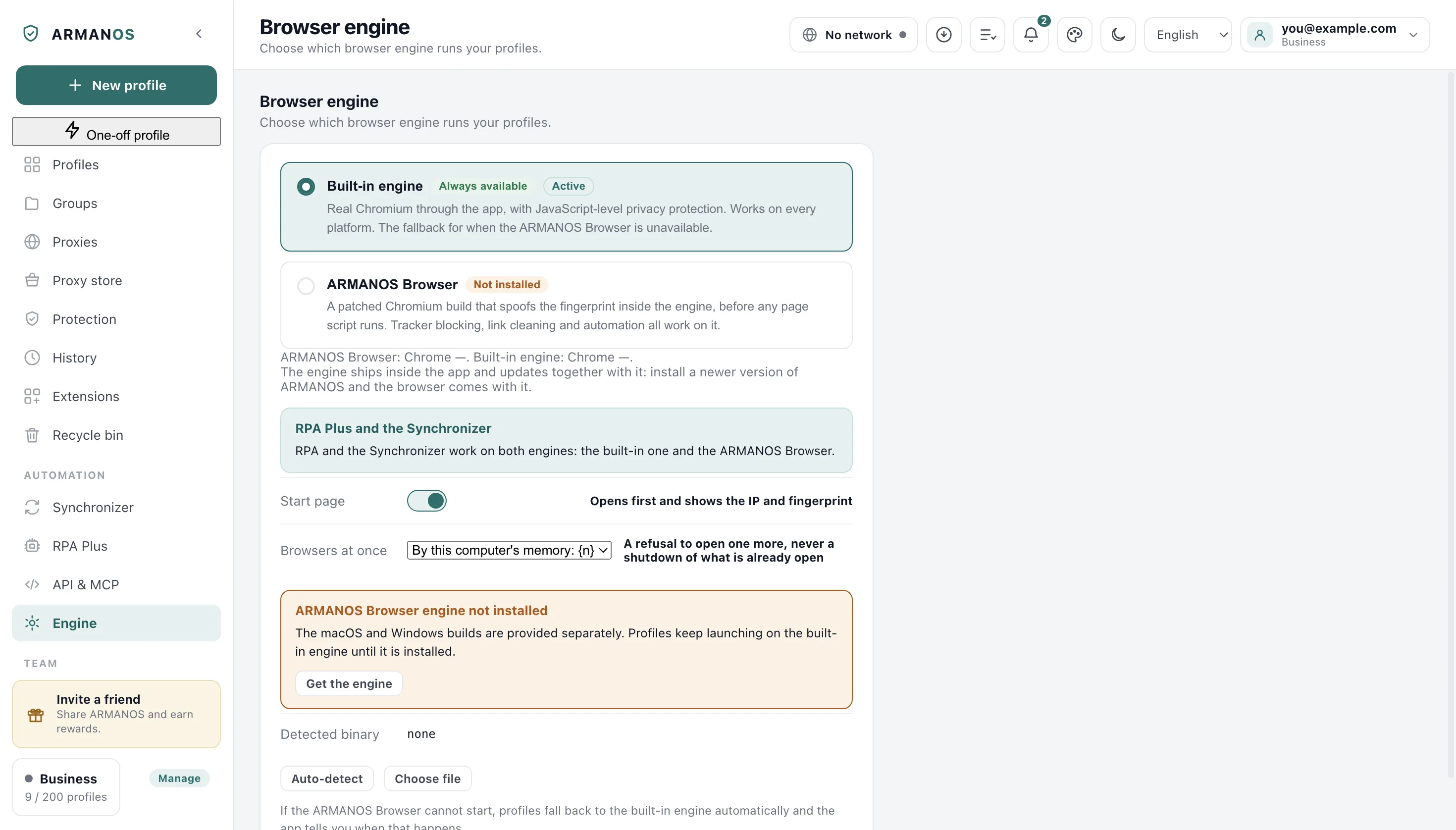
- ARMANOS Browser 153.0.7978.0
- Profiles opened at once
- 9 of 9
- Time to open, each
- 532 to 562 ms
- Crashes
- 0, three runs in a row
- Free memory, before and after
- 745 MB, then 207 MB
- Default limit on this machine
- 5, raised by hand for the run
Measured on 29 August 2026 on the real app and its ordinary launch, not on a stand-in. The default limit is computed from your own memory, and on the Engine screen you set your own number between 4 and 32.
Why a spoofing extension arrives late
An extension is JavaScript in the page, so even at the earliest injection point it corrects values the browser already produced. A getter can name one graphics card while the pixels are drawn by the real one.
Nine surfaces closed in the engine
ARMANOS assembles the device in C++ before the first script runs. Nine surfaces are closed that way, and each is proven by a marker found in the source tree at build time.
WebGL pixel readback
A page that reads pixels back gets them with this profile's noise.
Timezone, locale and calendar
The clock, the calendar and the way numbers and dates are written are the profile's own.
Font list
Fonts answer for the profile, not for the machine underneath.
Input and output devices
The count of cameras, microphones and speakers is the profile's.
Speech voices
Voices match the language the profile claims to speak.
Network readings
Connection speed, round trip time and type are the ones the profile names.
Heap limit
Clamped to the memory the profile declares, in Chromium's own steps.
WebGPU readback
An image captured through WebGPU comes back with the same noise as through WebGL.
Three mobile connection fields
Given to phone profiles only: desktop Chrome does not carry them.
Browser profiles and containers
A second profile in an ordinary browser gets its own cookie jar, history and extensions, and it costs nothing. What it shares is everything else: one font list, one graphics card, one screen, one exit IP.
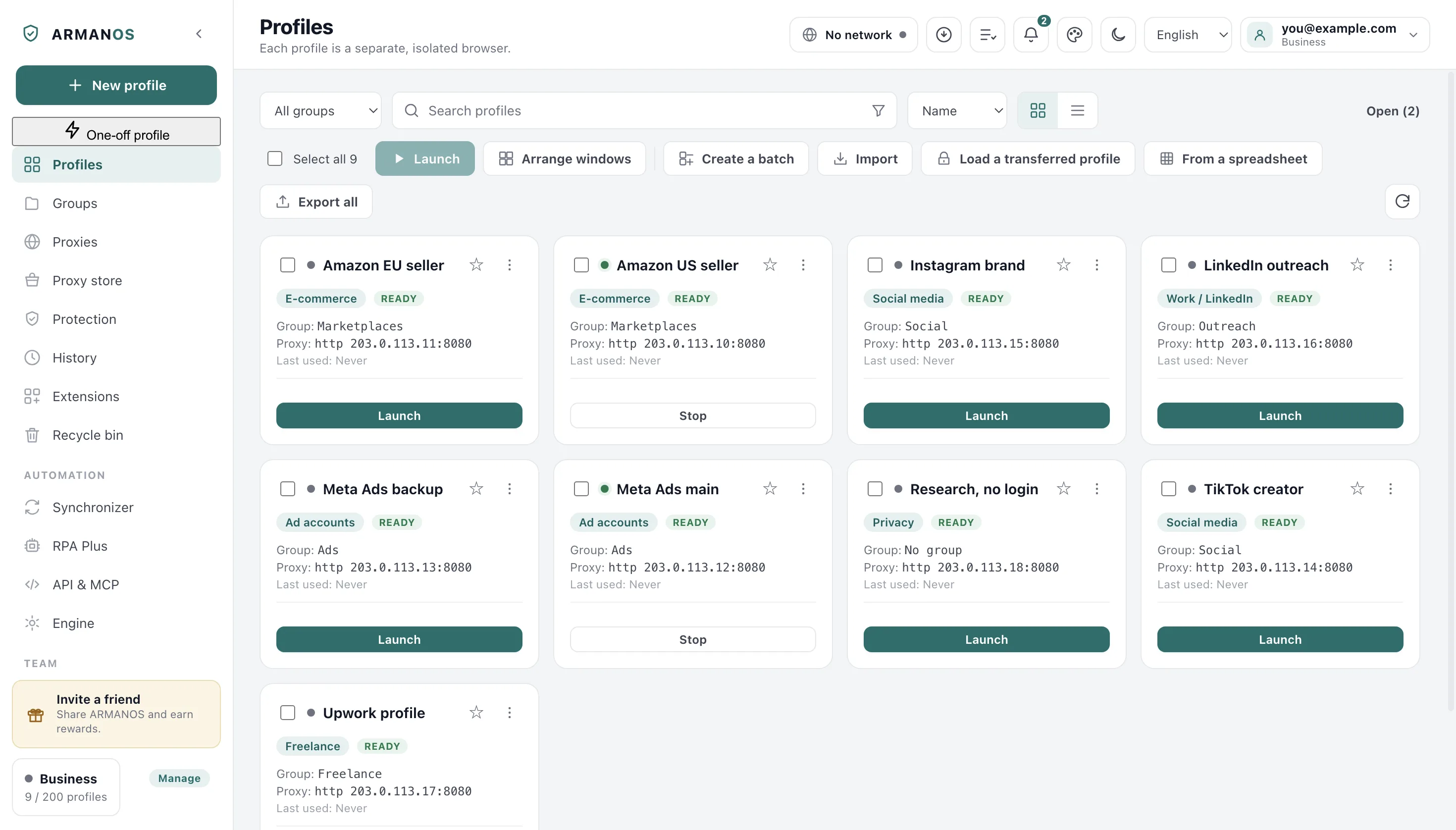
They also have no notion of a team. An ARMANOS profile carries its own device, its own proxy, a group and tags, and on a paid plan the whole team sees it, with no way for two people to open it at once.
Real hardware and its bill
A second laptop on a different line is a different device on a different network, with nothing substituted anywhere. It stops working as a plan at about the third device: fifty accounts means fifty machines to buy and keep.
Our unit is a profile and the price list is short. Devices are counted separately, and a session travels in an encrypted file or a folder you already sync.
50 profiles
The tier that covers fifty accounts, about 28 cents each.
$14 / monthOne extra profile
Added one at a time above your tier.
$2 / monthOne team seat
A colleague with a role and their own login.
$3 / monthA year up front
A quarter takes 10 percent off.
20% offFree plan
Forever, no card, on the same engine the paid plans run.
2 profiles
Eleven questions side by side
Read the dashes as scope, not as insults. A tool is not worse for declining a job it never advertised.
Three cells here belong to the other side. You can check any number in the ARMANOS column: it is either measured on the finished app or written in a file named below.
| ARMANOS | Incognito | VPN | Virtual machine | Spoofing extension | Second device | |
|---|---|---|---|---|---|---|
| Cookies and storage separated per account | Yes | Per session only | – | Yes | – | Yes |
| Device readings differ per account | Yes | – | – | One set per machine | Declared in the page | Yes |
| Where those values are set | In the engine, in C++ | Nowhere | Nowhere | In the guest system | In the page, after start | Real hardware |
| Own exit IP per account | With a proxy per profile | – | One exit for all | Whatever the host uses | – | With its own line or SIM |
| Timezone and language follow the exit IP | Yes | – | – | By hand | Declared only | By hand |
| Cost for 50 accounts | $14 a month | Free, does not do this | One subscription, does not do this | 50 machines to run | Free, does not do this | 50 devices to buy |
| Time to open one account | About 0.5 s, measured | Instant | Instant | A full boot | Instant | Pick it up |
| Many accounts at once on one machine | 5 on 8 GB, up to 32 by hand | One identity for all windows | One exit for all windows | A few per machine | One identity for all tabs | One per device |
| Shared with a team, with roles | Yes, $3 per seat | – | – | You build it yourself | – | Hand over the hardware |
| Driven by Puppeteer or Playwright | Yes | – | – | You build it yourself | – | – |
| Session moves to another machine | Encrypted file or a synced folder | – | – | Move the disk image | – | – |
When another tool wins
We would rather you picked the cheap tool when it is right. Every line below is advice we would give in person.
The rule is short: use ARMANOS when you need many lasting accounts that must not be linked to each other.
Incognito, for one throwaway login
One keystroke, nothing installed, nothing left behind.
A VPN, for the whole machine
It covers apps that are not browsers. A proxy inside a profile does nothing for your mail client.
A virtual machine, for depth
Its own kernel and its own operating system, where our profiles share yours.
An extension, for a browser you already use
Nothing new to install and no cost, if one account is all you have.
A second device, for one account worth more than the rest
No substitution anywhere. If losing it would cost more than a laptop, give it a laptop.
What we claim
The six lines below are printed next to our price list, and they describe capabilities rather than outcomes. What we sell is isolation and a device that stays the same.
We publish no numbers about other products, because we cannot measure them honestly. Every number here comes from our own code or our own measurement.
Isolated profiles
Separate cookies, storage and cache per profile.
Fingerprint parameters per profile
A stable set of user agent, language, resolution and hardware hints.
Proxy per profile
An HTTP or SOCKS5 proxy per profile, so its traffic follows its own route.
Link and tracker cleaning
Tracking parameters are stripped on every navigation and known trackers are blocked.
Pay for what you add
Start free, then add extra profiles one at a time.
Own engine, included
The substitution happens inside the engine, on every plan including the free one.
No brands, no invented statistics
What this does not do
- It does not promise that accounts will never be blocked. A separate session and a consistent device remove two reasons out of many. Behaviour, payment details, phone numbers and content stay yours to manage.
- It does not change your IP on its own. A proxy per profile does that, and you bring it or buy it. Without one, every profile leaves through your own address.
- It does not isolate as deeply as a virtual machine. Profiles are processes on your own kernel, and they share that kernel with each other and with you.
- Sharing a profile with a teammate sends its settings, not its session. Cookies and logins travel only through the encrypted transfer file or the sync folder.
- Isolation is between profiles, not between you and your own computer. Anything running under your user account can read the profile folders. The system seals passwords on Windows only: on macOS the key ships inside the program, and on Linux they are written as typed.
- The launch numbers come from one machine, a MacBook M3 with 8 GB. Your hardware will give different numbers, and the app computes its own limit from your memory.
How to check
Every claim above has a file behind it, and most have a stand that fails the build when the claim stops being true.
- Each profile launches into its own Chromium data directory, and deleting it erases that directory
- apps/desktop/src/lib/forkEngine.js · apps/desktop/test/purge-honesty.js · apps/desktop/test/purge-clears-cloud.js · apps/desktop/test/delete-leaves-nothing.js
- The fingerprint reaches the engine on the command line, and nine surfaces are closed in C++, each proven by a marker in the source tree
- packages/shared/src/index.js (ENGINE_CAPS, ENGINE_CAP_PROOF) · apps/desktop/test/engine-patches-real.js
- Page level substitution retreats for every surface the built engine declares, so the two never stack
- apps/desktop/src/lib/дыры-страницы.js · apps/desktop/test/страница-отходит-когда-движок-умеет.js
- The timezone and languages follow the proxy exit, asked of providers over TLS in turn
- apps/desktop/src/lib/exitGeo.js · apps/desktop/test/exit-geo.js
- The limit on browsers open at once is computed from this machine's memory, and nine at once was measured on the real app
- apps/desktop/src/lib/engine-config.js · apps/desktop/test/предел-открытых.js · apps/desktop/test/восемь-окон.js
- The price for fifty profiles comes from one table that the server and the site both read
- packages/shared/src/index.js (PLANS, tierFor) · apps/server/test/quota-follows-plan.js
Questions
- Does a proxy password ever appear on the command line?
- No. Measured on the shipped build, the form carrying a password made zero requests, so the password travels through a loopback bridge on this machine instead.
- How is the exit country decided?
- Through your own proxy: the app asks geolocation providers over TLS, one after another, and takes the first answer that parses.
- What happens on a surface the engine does not close?
- The app still substitutes it from the page, and that substitution steps aside on every surface the engine takes over. You never get two substitutions at once on the same surface.
- Can two people open the same account at once?
- No. The server holds a lock while a profile is open, a second launch gets «The profile is open on another machine», and two live sessions of one account from two places is the exact behaviour that gets accounts blocked.
- What does deleting a profile leave behind?
- Nothing on disk. The profile's own Chromium data directory goes with it, so cookies, storage and cache do not outlive the deletion.
Read next
The engine
What ARMANOS Browser 153.0.7978.0 changes in C++, surface by surface.
How a launch works
From the click to the first script, in order.
A proxy per profile
Protocols, the password bridge, rotation and the exit check.
Check every claim
Every claim on this site next to the file that keeps it.
Plans and prices
Tiers, extra profiles, seats and the two discounts.
Check it against your own browser first
The fingerprint check reads 12 values in your browser and sends nothing anywhere. In ARMANOS, open a profile and read the same values again.
Each difference in detail
Running a profile with nobody there
A profile can be driven by a program instead of a person.
What one account seat costs
Every way of keeping accounts apart has a price, and only some of them print it.
The address and what follows it
Changing where a connection comes out is the easy half.
Agreement inside one fingerprint
A platform rarely reads one value.
How a promise gets checked
Every method here promises something.
Where the session actually lives
Cookies and logins are what a platform reads first, and every tool here treats them differently.
Team access when someone leaves
Working one set of accounts with two or three people is ordinary work.
Page, extension or engine
Every way of changing what a site reads works at some depth.