Tej strony nie ma jeszcze w Twoim języku. Czytasz tekst angielski.
Open in profile
A link in the profile you choose
- http and https
- Addresses accepted
- Never
- The address on our server
- Both
- Engines
- 22 languages
- The wording of the button
A link belongs to an account
A message arrives with a link, and the account it has to open as is not the one your everyday browser is signed into. By hand that means finding the profile in the list, starting it, waiting for it, and pasting the address into a fresh window.
Four steps is enough friction that people stop doing it. They glance at the link in whatever browser is in front of them, and the account that was supposed to see it never does.
Here it is one action on the profile you point at. Everything the page then reads comes from that profile and nothing else.
Where the button is
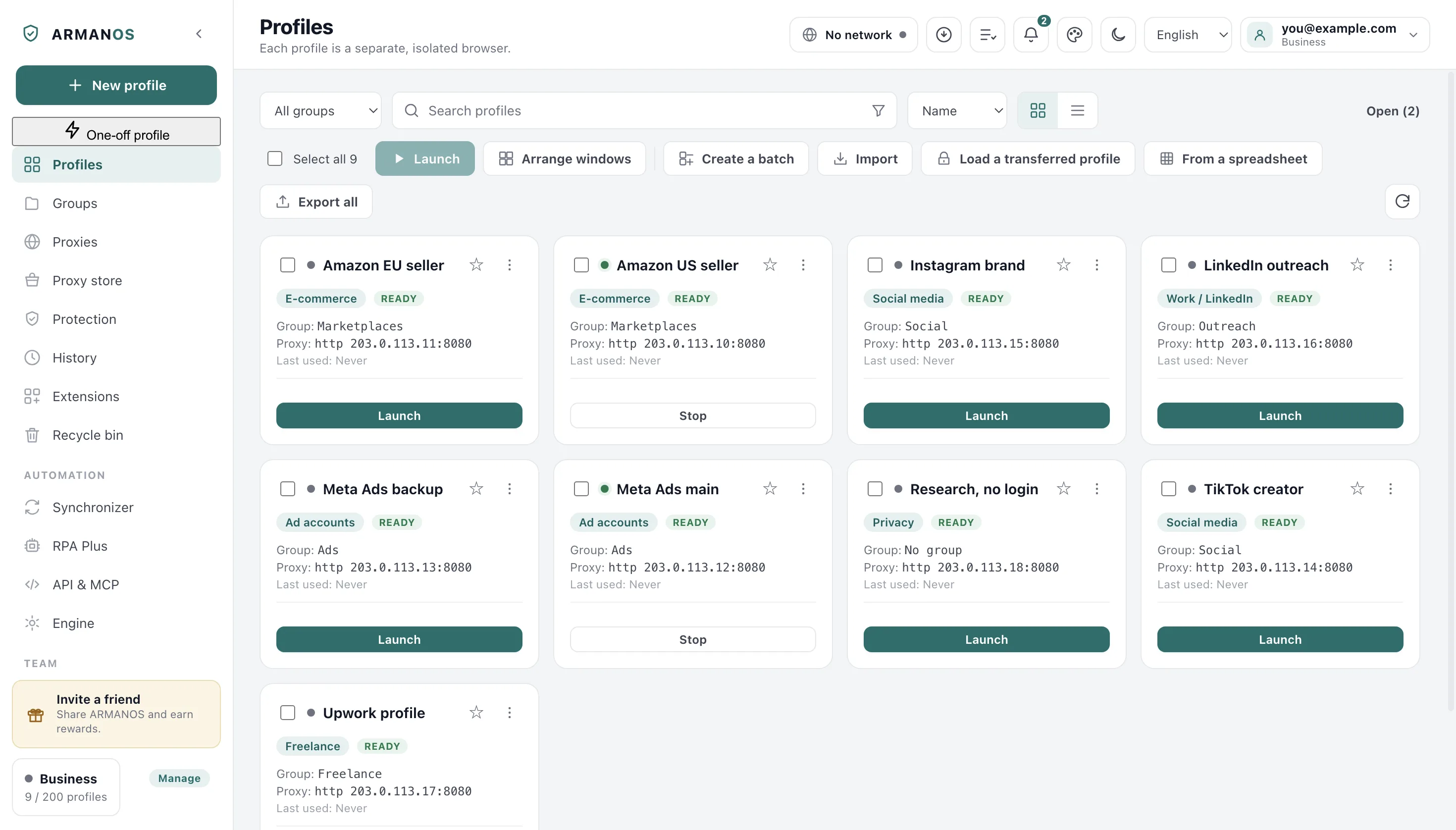
The entry sits in the profile's own menu, between Test fingerprint and Duplicate. Right-click a card or a row in the list, or use the three dots on the card.
Choosing the account first is the whole design. You are never typing an address into a window and hoping it lands in the right place.
- 1
Pick the profile
Open a link here is a line of that profile's menu, so the account is chosen before the address is.
- 2
Paste the address
A small window asks for the link and names the profile it is about to open in.
- 3
Read the answer there
A refusal stays in that window with the real reason, and a success closes it.
Only http and https
A person pastes this address, so the app checks it instead of trusting it. Anything that is not an ordinary web address is refused by name.
The reason is that the page opens with the profile's own rights. An address that reads files or runs code would do it from inside the account you were trying to protect.
| What you paste | What happens | Why |
|---|---|---|
| https:// and http:// | Opens in the profile | The two kinds an ordinary page comes in |
| file:// | Refused | It would read this computer's own files |
| javascript: and data: | Refused | They would run inside the profile as the page itself |
| Anything else | Refused | An unknown kind is not quietly attempted |
A closed profile opens itself
The account does not have to be running first. A closed profile goes through the same launch door as the Run button, with every gate that door has: the proxy, the fingerprint, the busy lock.
That last gate matters most. A profile a colleague holds on another machine refuses the link too as long as your account is reachable, and the refusal names the machine.
The seat is a real seat
The second window keeps the recipe
A profile already at work is never restarted for this. The page opens beside what is there, assembled from the same recipe that launch used.
A second page that skipped the proxy would put the account on the open internet from your own address, and a phone profile answering as a desktop is a contradiction any site can read at once.
What that looks like on screen depends on the engine.
| What the new page gets | ARMANOS Browser | The built-in engine |
|---|---|---|
| Where it appears | A tab of the profile | Another window of the same profile |
| Cookies and storage | The profile's own | The profile's own |
| Fingerprint | Substituted inside the engine | Injected before the page loads |
| Exit address | The profile's proxy | The profile's proxy |
| A profile started hidden | Stays hidden | Stays hidden |
| A phone profile | Stays a phone | Dressed as a phone first |
What a refusal tells you
A link that does not open is better than a link that opens somewhere you did not expect. Each way this can fail has its own sentence in the same small window.
A launch that did not happen passes its reason through whole instead of being replaced by a general phrase.
Not a web address
You are asked for one starting with http:// or https://, and nothing opens anywhere.
Held on another machine
The refusal comes from the busy lock and names the machine that is holding the profile.
No seat left
The ceiling on open profiles is reached, and the line tells you how many are open.
The page did not open
The profile is up and the address was not accepted by the engine, so the line names the profile.
The address stays on this computer
Nothing about the link travels upward. We do not receive it, count it, or learn the domain.
A list of the links other people send you would be worse than any fingerprint leak. So this action has no road to our server at all, and a stand holds it that way.
What this does not do
- It is not a proxy per tab. On the built-in engine an extra page is another window of the same profile, and a second exit behind shared cookies is the pattern that links accounts.
- It takes ordinary web addresses only. http and https open; file, javascript, data and the rest are refused, and the window says so.
- It is not free of resources. A closed profile starts a whole browser and holds a seat against the ceiling on open profiles until you close it again.
- It does not push past the busy lock, but the lock lives in your account: signed out, or with the server out of reach, there is nothing to ask and the link opens.
How to check
The action is one function, and a stand runs it on stubs.
- Only http and https reach a profile, and the address never goes to our server
- apps/desktop/src/main/main.js · apps/desktop/test/ссылка-в-профиле.js
- A closed profile is launched down the same road a flow step uses
- apps/desktop/src/main/main.js · apps/desktop/test/ссылка-в-профиле.js
- A second window inherits the launch recipe, hidden mode and phone dress included
- apps/desktop/src/main/main.js · apps/desktop/test/скрытый-режим.js · apps/desktop/test/mobile-window.js
- A profile opened this way takes a seat against the ceiling
- apps/desktop/src/main/main.js · apps/desktop/test/предел-открытых.js
Questions
- Does the profile have to be running?
- No. A closed one is launched first, through the same gates as the Run button, and the page opens once it is up.
- Can I send one link to many profiles at once?
- Not from this window: it asks for one profile and one address. A flow with an open-tab step is the many-profile version.
- Does the page go through the profile's proxy?
- Yes. It opens inside that profile's session, so it leaves by that profile's exit and carries that profile's cookies.
- What if a colleague has the profile open?
- It refuses and names the machine holding it, as long as your account is reachable. Two live sessions of one account is the thing the lock exists to prevent.
- Is the address written down anywhere?
- Not on our side. On your computer it becomes an open page like any other, so that profile's crash snapshot can remember it.
Open the next link as the right account
Install ARMANOS, keep a profile per account, and paste the link into the right one.